
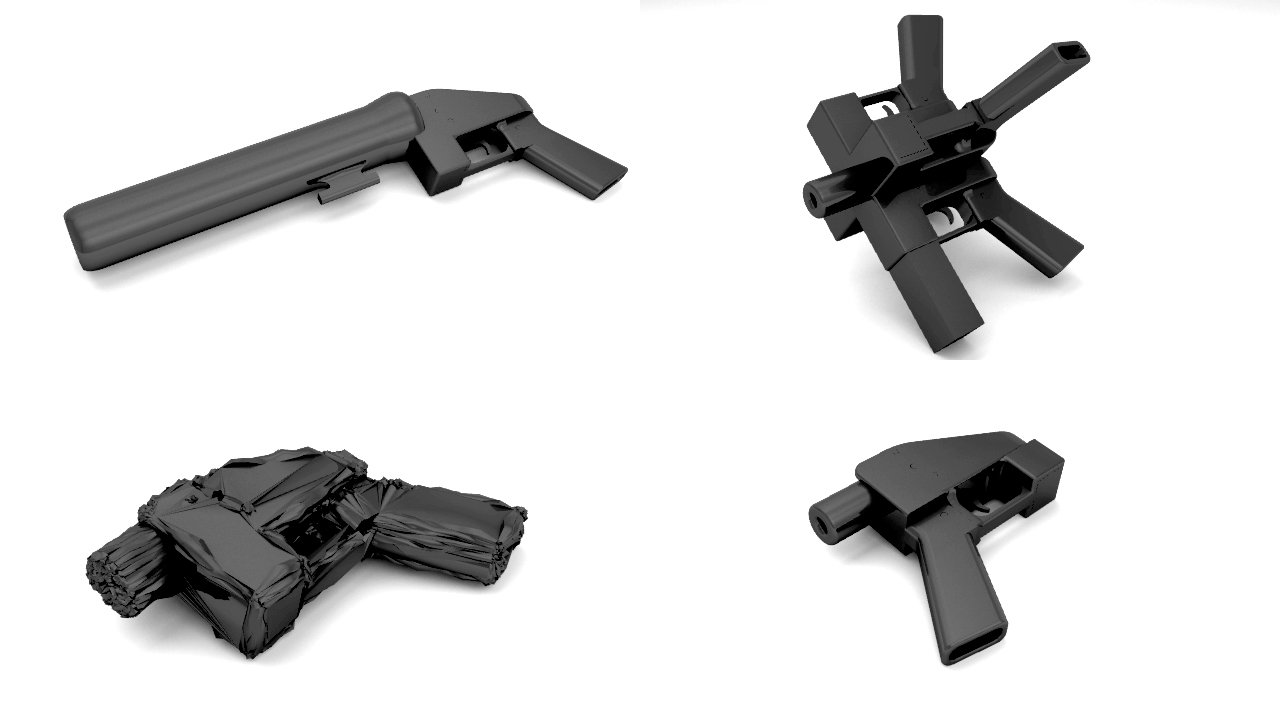
If 24-year-old University of Texas law student and part-time revolutionary Cody Wilson has his way, every human being in the United States, whether old or young, licensed or unlicensed, will soon be able to make a fully functioning, perfectly lethal gun in the comfort of their very own living rooms, for less than the cost of a few drinks.
Through his organization Defense Distributed, Wilson has been raising money to design the “Wikiweapon,” a gun that could be created completely from 3D-printed parts. 3D printers like the Reprap and Makerbot, which use computer-controlled nozzles to perfectly replicate digital models in materials like metal and plastic, have recently become more affordable and accessible to mainstream consumers at less than the cost of a new Apple computer. The machines make it possible for individuals to print out custom-designed objects without any of the mess, fuss, or regulation of a factory line — whether that’s a one-of-a-kind necklace or something deadlier.
The Wikiweapon might sound like a recipe for domestic terrorism and the end of gun regulation, enabling anyone with a minor complaint to settle it with violence. But Wilson, who when he first called me spoke in the deadened monotone of a James Bond villain but later flushed into the academic intensity of the excitable graduate student he is, sees it as a way to show how technology enables a new kind of individualism. “I’m really not some guy that’s just trying to get everybody to print out a bunch of guns and roll out,” he told me. “This is simply about, hey, look at your printable future.”
Wilson majored in English literature in college, is intensely interested in philosophy, and has never so much as gone hunting with a gun. “My dad always had a shotgun, but I never saw it much as a kid,” he said. “It wasn’t a big part of my family or growing up.” The idea for Defense Distributed first came in March 2012. After toying with creating his own Super PAC, Wilson decided to seek out a project that might change the world without getting bogged down in its existing order.
Benjamin Denio, a friend and consumer electronics specialist, suggested they become arms manufacturers, working with the new wave of DIY fabricating made possible by 3D printers. Wilson added the concept of giving away the printer-ready gun design freely, an ironic twist on the open source movement. “We styled it in terms of how you universalize the access to arms,” he explained.
During the following summer, Wilson returned to his hometown of Little Rock, Arkansas and hashed out the rest of the plan with friends over drinks at local bars. He decided to raise money for the project on a crowd-funding website, but knew it would never get past Kickstarter’s strict application process. Indiegogo, a similar site known for its looser standards and lack of Kickstarter’s all-or-nothing pay structure, seemed like the place to do it.
One night, holed up in the back of a friend’s office, Wilson recorded Defense Distributed’s introductory video. Alongside a slickly designed website complete with expert branding and a manifesto composed of pro-gun quotes from America’s founding fathers, the Wikiweapon funding campaign went live on July 27, 2012. It was only a matter of time until the powder keg blew up.

Printers are already standard tools in the gun industry. Large gun makers contract with companies like Stratasys, a Minnesota-based company that supplies a large percentage of 3D printers used worldwide, to print parts for testing. On a non-industrial level, however, printing any usable element of a gun is a rare feat. The physical forces acting on firearm parts tend to blow apart, melt, or fracture any flimsy material, so printing a weak part could prove deadly. That’s not to say it hasn’t been done.
In May 2011, a year before Defense Distributed began, a mechanical engineer and amateur gunsmith named Michael Guslick successfully fabricated the lower receiver of an AR-15 rifle (the same weapon that was purchased legally by the Aurora, Colorado shooter) with the help of an industrial Stratasys FDM1600 printer that he bought on the secondary market. The receiver is the element of the gun that houses the trigger mechanism and magazine, without which it wouldn’t function. As such, the receiver alone is officially classified as a firearm under U.S. law and is strictly controlled. The part usually holds the weapon’s serial number, which Guslick’s certainly lacked.
Guslick, whose mild voice and intensely technical internet persona is far more suited to a father tinkering in his garage than a terrorist, assembled the full rifle with parts that can be purchased online and fired it on July 1, 2012. The resulting shooting session was likely the first time a DIY gun with 3D-printed elements was successfully fired. Blogger Turomar at Ambulatory Armament Depot posted this video of a shooting session using his own AR-15 with a 3D-printed lower receiver in August.
Guslick has no interest in making political statements with his accomplishment. Successfully creating a gun with 3D-printed parts is just an intriguing technical challenge. “I’m really not a shooter or a hunter,” Guslick told me. “I see guns as fascinating mechanical systems… They’re good test objects.”
Guslick estimated he used $30 worth of 3D-printing plastic resin to create his lower receiver. Basic commercial receivers usually run around $100, though they have to be picked up at a licensed gun dealer instead of shipped directly to buyers. Aftermarket parts to complete the rifle would cost hundreds of dollars more, with the additional requirements of mechanical equipment and years of machining expertise. A pre-made AR-15 rifle would run a licensed buyer around $1000 and up in a legal arms store.
Though he disagrees with Wilson’s politicization of gun making, Guslick doesn’t see a huge problem with Defense Distributed’s project. In fact, he said, he could probably design a fully 3D-printed gun in a weekend, and it would likely be within the law.
“Legally, there’s nothing new” about printing a gun, Guslick told me. Many hobbyists already use legally available parts kits to build working guns on their own, and Guslick himself has put together an AK-47. A federal license isn’t even needed to build certain guns that aren’t for sale or trade. In its current state, Guslick pointed out, 3D printing simply is not the most effective method for mass DIY gun manufacturing. “If someone really wanted to make plans available for insurgents and freedom fighters to be able to produce their own weapons, coming up with plans that could be used with just a mill and lathe would be far more usable,” he argued.
“People seem to think that 3D printing has reached the point where you just hit a print button and out comes whatever you want. There’s more hype than substance at this point,” Guslick said. “If the technology progresses far enough, sure, someone might print out something more nefarious, but it’ll take a long time to get there.”

The Defense Distributed Indiegogo campaign started slow but met with support from viral websites like 4chan and Reddit. The project lasted 22 days and raised $1,708 before catching the eyes of Indiegogo’s moderators, who removed the project, citing “unusual account activity.” Wilson disputes any complains about the legality of the campaign. Defense Distributed is not selling actual weapons but simply sharing information, he argued. Yet he had always expected the project to be removed. “It was a perfect strategy — we got enough attention,” he said.
After the removal, the group took the campaign onto their own website, soliciting donations independently. Capitalizing on media buzz, they made it up to $10,000 when an international patron stepped forward. The anonymous backer pledged to double every dollar Defense Distributed made on the way to $20,000 and followed through with the gift, according to Wilson.

With the money raised, the group rented an industrial 3D printer from Stratasys and went ahead with development. They soon hit another snag, however. Stratasys’s legal team emailed Wilson notifying him that they would be taking the printer back. “It is the policy of Stratasys not to knowingly allow its printers to be used for illegal purposes,” an email to Wilson read. A removal team soon arrived at Wilson’s Texas house, where the printer sat still in its packaging.
Reaction to the project turned harsh as Defense Distributed came into the mainstream spotlight. In the Huffington Post, Josh Horwitz, the executive director of the Coalition to Stop Gun Violence, called Defense Distributed a “threat to our elected officials,” writing, “Wilson believes that his capacity to do violence to others is the only thing undergirding his status as a citizen.” In a recent phone conversation, Horwitz told me it’s not immediate physical danger he’s worried about with the Wikiweapon, it’s the potential harm of the philosophy behind it. “The idea that the government is the enemy… is completely outside the American tradition of political equality,” he said.
Horwitz worries that printed guns, lacking trackable serial numbers and background check procedures for owners, would entirely subvert what little gun control our country currently enforces. “The cost of entry would be so low that it would be very difficult to regulate,” he cautioned.
“Every time a new technology is being introduced, criminals are there to exploit it,” security expert Marc Goodman echoed in a fear-inducing June 2012 TED Talk. With the rise of 3D printing, he warns, gun restriction, particularly between international borders, will be gone forever: “You needn’t bring the gun anymore, you only need the 3D printer.”
Pro-gun groups aren’t exactly in favor of printed firearms, either. “The advent of 3D printers shows that technology continues to exceed the limits of gun control,” Gun Owners of America representative Erich Pratt wrote to me in an email. Still, Pratt continued, “We don’t feel there would be any constitutional authority to enact a 3D-printer ban.”
“The 3D printing community really hates it,” Wilson told me. “We’ve alienated ourselves from them.” Makerbot, a company that produces the kind of affordable 3D printers Defense Distributed hopes to design for, would not comment for this story, though their affiliate user-generated, open-source 3D printing directory Thingiverse does include downloadable models for printing lower receivers, silencers, and bullet magazines, among other weapon parts.
None of this has really fazed Wilson or Defense Distributed. To fill the absence of a 3D printer left by Stratasys, Wilson is “in contact with two different resellers right now, and other people have offered me their printers straight up,” he told me. The Wikiweapon continues to find an appreciative audience in countries where guns are more strictly regulated than in the U.S. — “Russians want their guns back. They are pissed off about it,” Wilson laughed.

Wilson has set up a new LLC and is in the process of breaking up Defense Distributed’s operations into three separate entities, “so legal attacks will only be able to take out one or two at the same time,” he explained in late October. They are seeking out Type 7 licensing, which would make the company an officially sanctioned manufacturer of arms and ammunition. A testing location in San Antonio has been secured.
On November 9, Wilson emailed me with an update. The company will soon hold its first board meeting and is pending non-profit status. He expects an uptick in contributions helped along by the aftermath of Barack Obama’s re-election, which has left political conservatives “totally adrift,” he wrote. He has interest from “certain high-net-worth individuals” for another round of funding, which could go toward purchasing extra equipment. In short, the project is well on track. “I expect we’ll print within three weeks,” the note ended.
Wilson’s 3D-printed gun could indeed disrupt gun control forever, but its biggest impact might be as a symbol of a larger idea rather than a tool for murder. It shows the path toward a future in which technology enables individuals to bypass the government, circumventing established routes of communication, avoiding federal regulation, and facilitating collaborative action. “In little, banal ways that we all agree with, we don’t realize it, but we’re all becoming anarchists,” he said, citing the illegal-yet-thriving online souk Silk Road, peer-to-peer file-sharing sites like the Pirate Bay, and the rise of the independent crypto-currency Bitcoin.
“I think our future is going to be about preparing our own way in bits and pieces, places and spaces. Not all at one time, not some grand revolution where we all march in the streets, but a sea change,” Wilson said, his voice growing distant. “More and more, our daily activities are just done without a statist intermediary, because that intermediary,” the centralized government, in other words, “is going to disappear.”
(Illustrations: Jake Lawrence.)
Author Kyle Chayka can be reached at chaykak@gmail.c


I really hate the sensationalism that gets tied to anything gun related. They are just tools. I've owned them and been around them my entire life and don't know a single person that has been shot with one. Media hype should focus on other issues that need addressing, like our country's health and educational woes.
I, too, have owned guns for many years, and have been around guns for most of my life. However, a dear friend of mine was in the audience in Aurora, CO. I miss him every day.
So, I guess things are a bit more complicated, huh?
There are a lot of problems with the information in this article.
3D Printing remains VERY expensive. It is a tool for rapid-protoyping, but not yet a realistic tool for production.
The sub $2,000 3d Printers you reference only print soft ABS plastics. You can print prototypes, toys, and other plastic models.
The type of 3D Printer needed to print steels alloys is vastly out of reach for most people, being more than a luxury car.
Home 3D printing is complex, and still requires a good knowledge of 3d modeling.
We are further from this reality than this article suggests. 3D Printing metals is still far from accessible, and even when it becomes cheaper, it will be difficult to beat the production cost of old fashioned casting/molding.
Majored in English Literature, and is interested in philosophy….in other words, doesn't expect to ever have a real job.
You know, like Tim O'Reily.
Nothing good has come of having guns in society. The small-dick brigade of religiously devoted gun-nuts who think this is a good idea are so completely unable to understand what damage guns are doing to the USA they think the solution is MORE GUNS.
And the worst impact will be to other societies who have implemented gun control and have far better functioning societies than the USA.
It takes a special kind of retarded to think that a right to guns is something good. Takes another type like above to suggest that a weapon is just a tool. Yep – it’s a tool for killing. But congratulations on repeating some nonsense you heard from the NRA.
Nothing good will come of this – absolutely nothing.
"Nothing good has come from having guns in society."
Oh, I don't know, how about us becoming a free country with all the other rights I'm sure you enjoy. Like the right to say what you want, even if it does make you sound like an idiot. Or the right to practice any religion you want. Or the freedom to vote for who you want in office. Or maybe, just freedom in general.
And what about the hundreds of thousands of times yearly where people use guns to successfully defend themselves or loved ones. Just because you only choose to focus on the bad scary parts doesn't mean that's the only use they have.
"Hundreds of thousands of times"
Proof, motherfucker.
Between 1987 and 1990, David McDowall found that guns were used in defense during a crime incident 64,615 times annually (258,460 times total over the whole period).[McDowall] This equates to two times out of 1,000 incidents (0.2%) that occurred in this period.[McDowall] For violent crimes, assault, robbery, and rape, guns were used 0.83% of the time in self-defense.[McDowall] Of the times that guns were used in self-defense, 71% of the crimes were committed by strangers, with the rest of the incidents evenly divided between offenders that were acquaintances or persons well known to the victim.[McDowall] In 28% of incidents where a gun was used for self-defense, victims shot at the offender.[McDowall] In 20% of the self-defense incidents, the guns were used by police officers.[McDowall] During this same period, 1987 to 1990, there were 46,319 gun homicides,[FBI] and the National Crime Victimization Survey estimated that 2,628,532 nonfatal crimes involving guns occurred.[McDowall]
McDowall, David, Brian Wiersema (1994). "The Incidence of Defensive Firearm Use by US Crime Victims, 1987 through 1990". American Journal of Public Health 84 (12): 1982–1984. doi:10.2105/AJPH.84.12.1982. PMC 1615397. PMID 7998641.
Uniform Crime Reports, 1987-1990. Federal Bureau of Investigation.
Probably "Hundreds of thousands of times". The report does not cover self defense uses where the self defense gun was not fired. If the robber saw you with the gun and ran, that would not have been counted.
A more personal side – it's not hundreds of thousands, but it's hundreds over the last several months.
http://reddit.com/r/dgu
http://www.pulpless.com/gunclock/stats.html
http://www.guncite.com/gun_control_gcdguse.html
A gun doesn't have to be used to actually make defending yourself successful. And learn how to use google, "motherfucker."
"interested in philosophy." why did you feign on that one? why didn't you just come out and say he read some ayn rand in highschool, just like every other sociopath, i mean anarchist, from oswald to james holmes?
Scary stuff. Unsurprisingly this moron is more interested in making money from his little venture than the repercussions it could have for society. Immoral.
Really? By freely giving away designs developed by a non-profit organization? What's his master plan for getting rich from that arrangement, you think?
Love the 8-bit graphics on this piece, BTW. So good.