
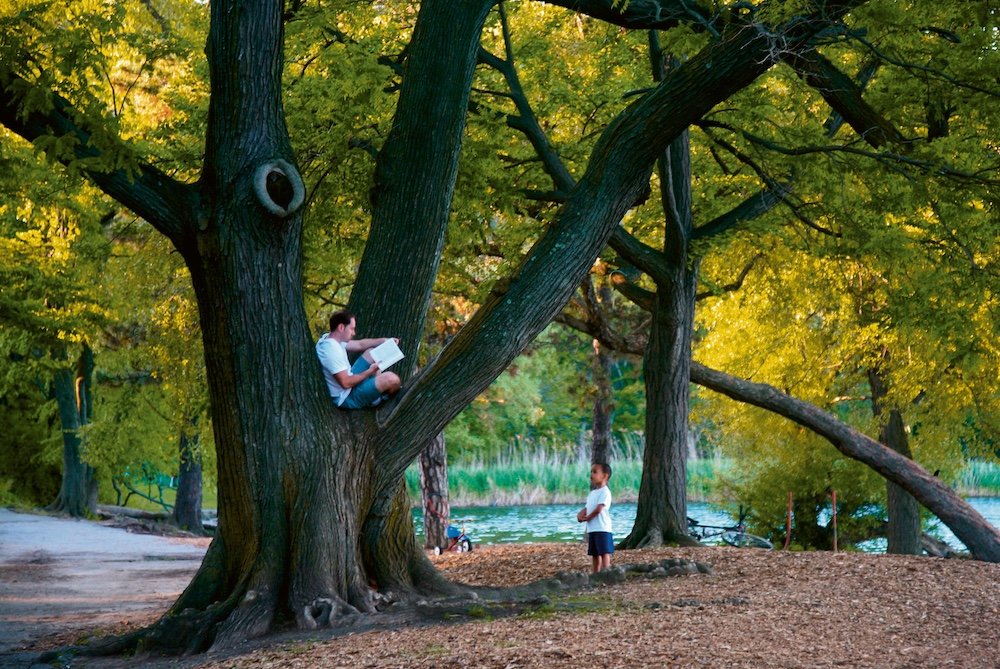
Prospect Park, 2010 © Jamel Shabazz, 2025
Fifty years after Jamel Shabazz first started making photographs, he returns to his roots with Prospect Park: Photographs of a Brooklyn Oasis, 1980 to 2025 (Prestel) — the place where it all began. As a young boy first learning the landscape of Red Hook, Brooklyn, during the 1960s, Shabazz remembers the after school visits to the park filled with the magic and wonder of discovery of the natural world that lay just beyond its 19th-century stone masonry walls. Just a century earlier, landscape architects Frederick Law Olmsted and Calvert Vaux reimagined this majestic expanse as nature at its most sublime, at once mysterious, romantic, and enchanting for its ability to erase the outside world. Here the relentless grind of rubber meets road disappears and in its place, life returns to a more leisurely pace.

Prospect Park, 2012 © Jamel Shabazz, 2025
After graduating high school, Shabazz enlisted in the U.S. Army, serving three years before returning home during the summer of 1980. Now living in East Flatbush, he was back on the block only to discover how much had changed. “I started to get word that a lot of young men were dying at the hands of other young men,” Shabazz says. “I knew their older brothers and sisters, so it was very personal for me. I needed to find out what was going on. I wanted to engage people and found out that photography drew them in because it made them feel special. Kids took pride in the way they dressed. They had fresh cuts, nice gear, and the girls were the same way. They went to school dressed to impress.
When the school year started in 1980, Shabazz began making trips to local high schools to chop it up with the kids. In the mornings, he’d visit Samuel J. Tilden and in the afternoons, he would head over to Erasmus, carrying his camera and curated photo albums. “They would brief me on what was happening,” Shabazz says. “I was concerned for their future and trying to give them guidance. Then I would photograph them as evidence of the conversation. I let them know these images would mean something one day, so put your best at it and I had to get it right the first time because I didn’t have a lot of film. I was very intentional about everything that I did. I’d make prints and give them one at no cost, and that helped to build a lot of relationships.”

Prospect Park, 2014 © Jamel Shabazz, 2025
Focused and disciplined, Shabazz arose every morning at six and headed over to Prospect Park for his daily run along the horse trail. Away from it all, what was hiding in plain sight made itself known: the park was the perfect studio for his emerging photography practice. Here, he could freely experiment with portraiture, street photography, landscapes, and documentary work. The camera guided him like a compass, taking Shabazz on a spiritual journey that would span his 20-year career as a police officer working in the New York City Department of Correction.
“It is quiet and beautiful, and everyone here seems like they are searching for inner peace. It was a certain frequency that I just loved and that became my base,” he says. “When I became a Correction Officer, I needed to decompress from the violence I was witnessing, and it became an oasis where I could heal myself. I took in everything: the sunrises and sunsets, the sound of the birds, the diversity of the people. One of the first things that directed me to social documentary photography were the Vietnamese and Cambodian refugees who lived in the area and patronized the park. I realized I needed to understand why we met on this path of life. I started to recognize it as a journey, and the park was the starting point.”

Prospect Park, 2014 © Jamel Shabazz, 2025
Among those Shabazz encountered on the path was Richard E. Green, a Vietnam veteran, photographer, and community organizer who founded the nonprofit Crown Heights Youth Collective in 1977 and contributed an essay to the book titled “Drummer’s Grove” in celebration of this fabled Sunday gathering of percussionists in the park. Shabazz first met Green during one evening in the park during the Fall of 1980. “I went to see the sunset, and ahead of me was an individual my height with an Army field jacket on. I knew immediately he was in Vietnam, and I wanted to know more about the war and those who served. Richard was the big brother I never had,” he says.
Every photograph in Prospect Park is layered in history of people and place, of Shabazz’s unwavering commitment to trusting the process. For many Vietnam vets, the drums became a form of therapy to manage post traumatic stress; for Shabazz, the camera did the same while working as a CO for 20 years. He would retire in 2003, two years after his groundbreaking debut, Back in the Days, was published, but the recovery process would continue for years. Prospect Park was equal parts sanctuary and studio, the camera an instrument with which he could compose tender reveries of humanity in its most idyllic state, living together in nature with dignity and grace.

Prospect Park, 1981 © Jamel Shabazz, 2025
Follow Miss Rosen on Twitter
