
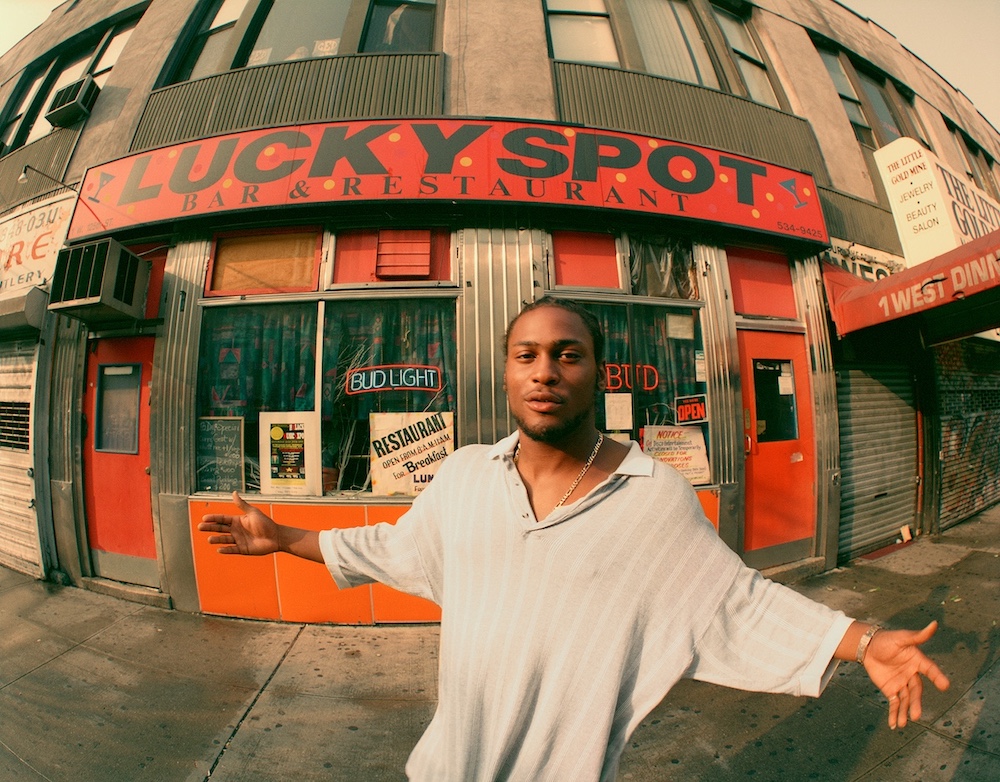
Photo: ©Jamil GS. D’Angelo, Harlem, July 1995
The untimely death of Michael Eugene Archer, better known to the world as D’Angelo, on October 14 marks the passing of not just a man but an era unto itself. In his 51 years on earth, D’Angelo created just three albums — Black Sugar (1995), Voodoo (2000), and Black Messiah (2012) — each revolutionizing the sound of the times, much like his idol, Prince. The singer, songwriter, musician, and producer emerged at age 21 on the global stage with his first album, “Brown Sugar,” which dropped July 3, 1995, at the height of Hip Hop’s golden age. With his crisp straightbacks and leather trench, D’Angelo was the epitome of Black cool, driven by a love for music far greater than the trappings of fame, fortune, and wealth. His arrival signified a new generation of R&B that would blossom into NeoSoul throughout the second half of the decade.

Photographer Jamil GS remembers ’95 as an extraordinary time of innovation, creativity, and style. That July, he had back to back sessions with artists just getting their start including D’Angelo, Mos Def, Jay Z, Jeru the Damaja, Ghostface and Raekwon. “The reason I gravitated to working with musicians was my love of music and respect for the people producing it,” says Jamil, whose father, jazz saxophonist Sahib Shahib, played with Thelonious Monk, Quincy Jones, and John Coltrane. Growing up in Copenhagen surrounded by music, Jamil was drawn to Hip Hop, writing graffiti before taking up photography. He moved to New York, his father’s hometown, in 1990, and soon began shooting for magazines including i-D, Dazed, and The Face.
“That was the beginning of my journey as a photographer. I was working out of my apartment, but I took to the streets and made that my studio,” Jamil says. “There was no playbook yet. Everything that was Black became ‘urban’ and art departments at the labels were looking at stuff someone else had done, like ohh that sticks. My approach was different. The experiences I had of the music were sonically so rich and valuable that I wanted to do my part to uphold it and share that with the world.”

He received a commission from The Face to photograph a new artist on the come up named D’Angelo. “When I first heard him, I was like, who’s this cat sounding like a young Marvin Gaye?” Jamil remembers. “Then I heard more and felt the edge, how the production had the street element, the twang of the times, and that he hailed from the South. I wanted to shoot him somewhere that resonated. My grandparents and my father came from the South and settled in Harlem, and I wanted to trace some of those footsteps.” Jamil headed uptown and scouted locales that read as Uptown Classic at first glance: Lucky Spot on 125th Street and Fifth Avenue; 125th Street and Lexington Avenue; 116th and Fifth Avenue; and a corner with Dragon, a Chinese restaurant that still had a colorful spray of flags hanging overhead. They met on a weekday afternoon as the golden hour approached. “I loved shooting in the afternoon sun,” Jamil says. “I like the magical glow and felt like D’Angelo’s sound represented that; it was really warm, spiritual, human. His whole vibe was like the sound of an afternoon song.”

Jamil’s approach to shooting was simple and understated. He asked D’Angelo’s publicist and label rep to wait inside their van to avoid drawing attention to the photo shoots. “Still it was Harlem, and people are curious,” he says. “I had a big camera and people thought it was a film camera, like we were shooting a movie. Quickly a crowd would gather, and then a few people asked, ‘Are you that ‘Brown Sugar’ guy?’ It was that new. They didn’t know his name yet.”
But soon the world would learn it, and learn it well — D’Angelo, artist, musician, poet whose devotion to craft embodied the ethos, “less is more” like no one else. With his passing, we are reminded of what matters most: love, care, and respect as stewards of the earth. “There’s a movement now, slow living, which is basically what it was like back then: when you avoid distractions and focus on diving deeper,” Jamil says. “D’Angelo is a great example of what is possible when you do that. His music is going to stay forever.”

Follow Miss Rosen on Twitter
