
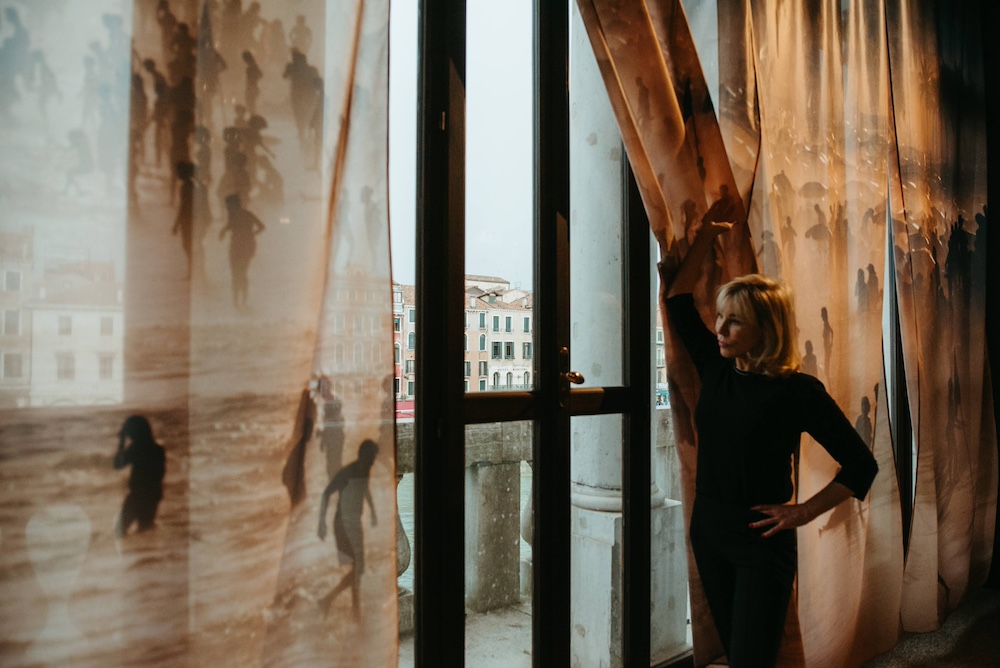
Sandra Cattaneo Adorno by Malvina Battiston, Venice, 2024.
[Take a deep breath]
[Exhale]
[Drop your shoulders]
[Close your eyes]
These words, chosen to introduce In Minor Keys by the late Koyo Kouoh, are an elegiac invocation from the first African woman to curate the Venice Biennale. Although Kouoh would pass just one year before the 61st edition of the fabled festival opened on May 9, her vision meets the moment without pandering to the geopolitical currents shaping the contemporary art world. Here, art is restored to its rightful place as “thresholds between lifeworlds and temporalities” that exist only in the object itself.

Kouoh’s words are an invocation and a release, an invitation to step away from the known and enter a world of imagination where our very presence fills in the blanks. It is a sentiment that lies at the heart of Fragments of Light, Sandra Cattaneo Adorno’s new exhibition presented at Palazzo Bembo during Personal Structures: Confluences, which runs parallel with the Biennale. Curated by the artist in collaboration architect Danilo Vespier, and art historian Andrea Verganti, the exhibition showcases Cattaneo Adorno’s transformative approach to street photography, enveloping us in a mellifluous blend of sight, sound, and motion to explore the inherent fragility and unstable experience of perception.
After taking up photography at age 60 in 2013, Cattaneo Adorno has used the camera as her compass to move throughout the world, fostering a sense of belonging through the act of making art that evokes the glittering sun, sand, and surf of her native Rio de Janeiro. Fragments of Light picks up where her previous works — Águas de Ouro, Scarti di Tempo, and Ten Years — left off, pushing the boundaries of street photography into new realms while combining playful curiosity with a bittersweet yearning that Brazilians call saudade, melancholic feelings of nostalgia for a love long gone.
It’s an apt meditation of inherent fragility of our present times while offering a paradigm shift: letting go and following your heart. Here Cattaneo Adorno reflects on her journey as an artist and creating work that brings to life Koyo Kouoh’s idea of “an exhibition that invites listening to the persistent signals of earth and life, connecting to soul frequencies.”

Please take us back to 2013, when you took your first photography workshop with Alex Webb and Rebecca Norris Webb, and describe the moment when you fell in love with photography.
Sandra Cattaneo Adorno: It was my daughter Gwen who invited me to join her in the workshop run by Alex and Rebecca as a present for my 60th birthday. I didn’t know what to expect, but I accepted because I thought it could be a good excuse to spend some time with her. At first, I didn’t know what to do with my camera and the technical side of taking pictures felt really daunting. All the other participants were much more advanced than me, I must have been the worst in the class! But as I found myself out in the street and looked through the viewfinder, something clicked. It is difficult to explain precisely what happened, but I felt a buzz running through me. It was both a challenge and a joy, and I wanted more of it.

What drew you to street photography and the freedom of creating work wherever you are?
For me the biggest excitement of photography lies in framing a scene that is unpredictable and uncontrollable. It rests in the alertness of being in the moment and capturing that split second in which everything – people, gestures, colors, shapes – come together in a meaningful composition. Before I started photographing, the street was for me a place that I used to go from A to B without being too conscious of what was happening around me. Now it is a bit like a canvas where infinite possibilities might unfold.

What inspired you to work in metallic gold and silver inks to create Águas de Ouro (Portuguese for “waters of gold”)?
I wanted to create a dreamlike atmosphere that could evoke both my memories of Ipanema and the joyous experience of the people who visit the beach now. The book was printed using three different kinds of metallic ink techniques: golden ink on black paper, four colors on a silver base, and blue ink on white paper. It was a bit of a leap of faith, as even the printers had never used this technology before, but it was a fun experience and I am very pleased with the result.

What drew you to explore the more abstract elements of photography for Scarti di Tempo (Italian for “scraps of time”)?
With Scarti di Tempo, I pushed the subjective quality of my photos even further, creating images that were very abstract and mysterious. I have always enjoyed playing with what is real and what isn’t in a photograph, to make the viewers challenge what they are seeing. When the pandemic hit in 2020, this interest became more compelling, as the world around me felt increasingly absurd and detached from reality. I wanted to convey part of this estrangement in the book, while also celebrating the ability of photography to evoke a sense of mystery and wonder.

Where your last book, Ten Years, is printed in gold like the sun, your new exhibition, Fragments of Light, is silver like the moon. How has seeing your work printed in different colors and tones deepened your understanding of photography?
I am naturally drawn to color when I photograph, maybe because I was surrounded by so many strong hues when I was growing up in Brazil. I found it fascinating to explore the possibilities offered by changing the way that a photo looks when printed. Depriving an image of color makes it more abstract in a timeless way, but while the golden ink I used in Ten Years felt more celebratory, the silver one of Fragments of Light is more subjective, so the visitors can tinge it with their own emotions.
My wish is to activate the imagination of the visitors, making them interact with my work with fresh eyes, without preconceived ideas as to what they will see or experience. I believe that one of the most powerful aspects of art rests in its ambiguity and its ability to evoke a sense of mystery and wonder; I might want to ask some questions, but I am not interested in providing the answers.

Photos courtesy Robert Mann Gallery
Follow Miss Rosen on Twitter
