
During his first trip to New York in 1981, British photographer David Corio made his way to the West Side Highway on a Sunday morning, ambling through the detritus of the city’s once majestic waterfront when he spotted gang members posted up on an abandoned pier. He cut through the Meatpacking District back when blood still ran down its cobblestone streets, and happened upon regulars leaving the Anvil, the legendary gay BDSM club nestled in the basement of the Liberty Inn on 14th Street. Searching for the perfect beat, Corio was walking north where he heard Hip Hop pumping at the Roxy, a rollerskating rink turned nightclub on 18th Street.
Corio entered the club and snapped a shot of b-boys practicing their moves, one of which was the Roxy’s resident DJ, Grand Mixer D.St, which later appeared on the cover of Fans and Clubbers 1978–1995 (Cafe Royal Books). “There was barely any Hip Hop being played on the radio,” Corio remembers. “I had been to a tiny Hip Hop club in London a few times and Grandmaster Flash & The Furious Five had played in London six months earlier but the music was still largely unknown and unheard.” The only way for most people to follow the scene was to catch it live.

As a regular contributor to music mags like New Musical Express (NME), Corio had established himself at the forefront of the UK’s soul and reggae scenes. Hip Hop was a natural continuum, which he chronicled on both sides of the Atlantic. On November 23, 1982, the New York City Rap Tour crossed the pond, bringing the four elements of Hip Hop to London for the first time in a single showcase at the Venue, an old cinema in Victoria. “There was an amazing energy the whole night,” Corio says. “I think the audience quickly became aware that something groundbreaking was happening before their eyes.” The main stage featured Africa Bambaataa and Grand Mixer D.St on the wheels of steel, in front of a massive backdrop being painted by FUTURA, DONDI, PHASE II, and Rammellzee.
There was a second stage in the round featuring Rock Steady Crew and Double Dutch girls. “For me, breakdancing was the most impressive thing on a photographic level,” Corio says. “Frosty Freeze, Ken Swift and Crazy Legs were all quite different and had amazing moves. It was acrobatics, contortionism, and high energy moving to wild beats. It was electrifying to watch, and the audience were dumb-founded, I think. It’s hard to overstate how important this show was. The music press here regarded Hip Hop as a fad that would last for a year or two and then disappear.”

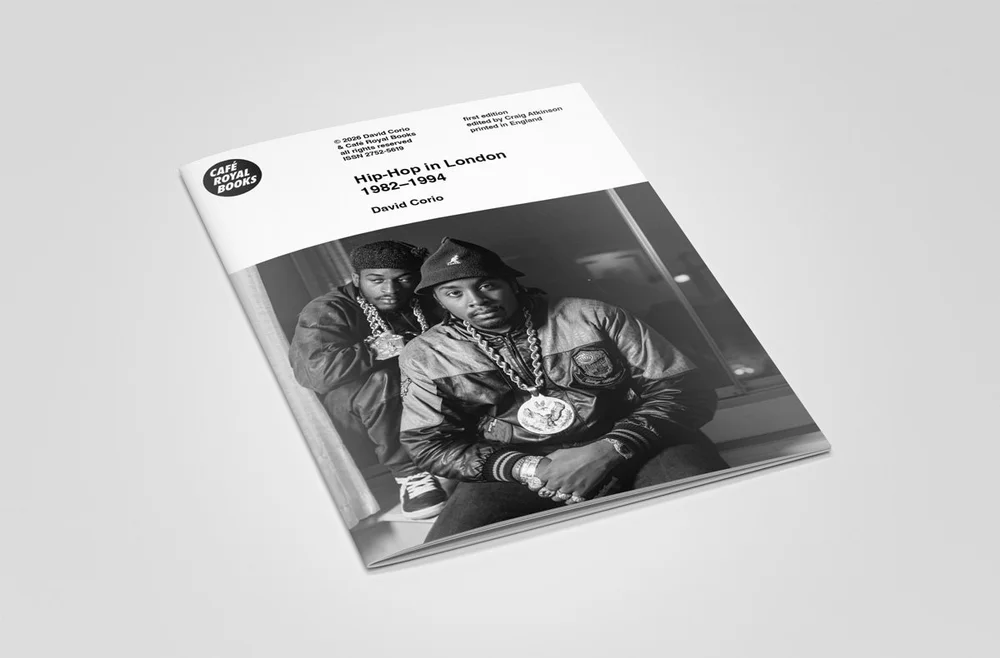
But they were wrong, as the establishment so often is. Instead, Hip Hop spread through London, taking root in the clubs and pirate radio shows where it flourished despite minimal commercial success. This is where Hip-Hop in London 1982–1994 (Cafe Royal Books), begins. Corio returns to his archive, bringing together images of Run DMC, LL Cool J, Public Enemy, and Juice Crew All Stars Big Daddy Kane, Biz Markie, Marley Marl, MC Shan, and Roxanne Shanté made on the streets of London and at the shows for an intimate look at the dawn of Hip Hop’s rise to global domination.
It was another era as Corio’s photograph of the Fat Boys attests, as they rock the mic wearing matching satin jackets and coon skin caps at a local Pizza Express to promote their new single, “All You Can Eat.” Corio remembers when the PA (personal appearance) was a common event. “If an artist was in town for a few days to plug their new single, they might not have enough material or proper backing to do a whole show. Acts would perform to a backing track, do a couple of tunes, and then on to the next venue,” he explains. “This was a meet and greet (and eat!) event at lunchtime.”

But perhaps it is his photo session with Biz Markie at Kensington Court that best embodies the spirit of the times. When the Cold Chillin ‘88 Tour came to town, Corio was given 30 minutes to photograph Marley Marl, Big Daddy Kane, MC Shan and Biz so he took them out of the record company offices one by one for a 10-minute portrait session on the street. Kane was calm, cool, and collected and Shan hit the lamppost like Gene Kelly in Singin’ in the Rain, while Marley Marl posted up on a Mercedes looking like time is money and there was work to be done.
But “Biz was a photographer’s dream,” Corio says. “He hammed it up for the camera, pulling a different pose for each shot. He climbed on to the hood of a parked BMW and leapt off with his rope chains flying, then stuck his face a couple of inches away from the camera, pulling faces and sticking his tongue out. I didn’t need to give him any direction at all and managed to shoot off a whole roll of film in barely a minute or two. Big Daddy Kane by contrast was silent and immobile but he had such an imposing character he was good to photograph in a very different way.”


Follow Miss Rosen on Twitter
