
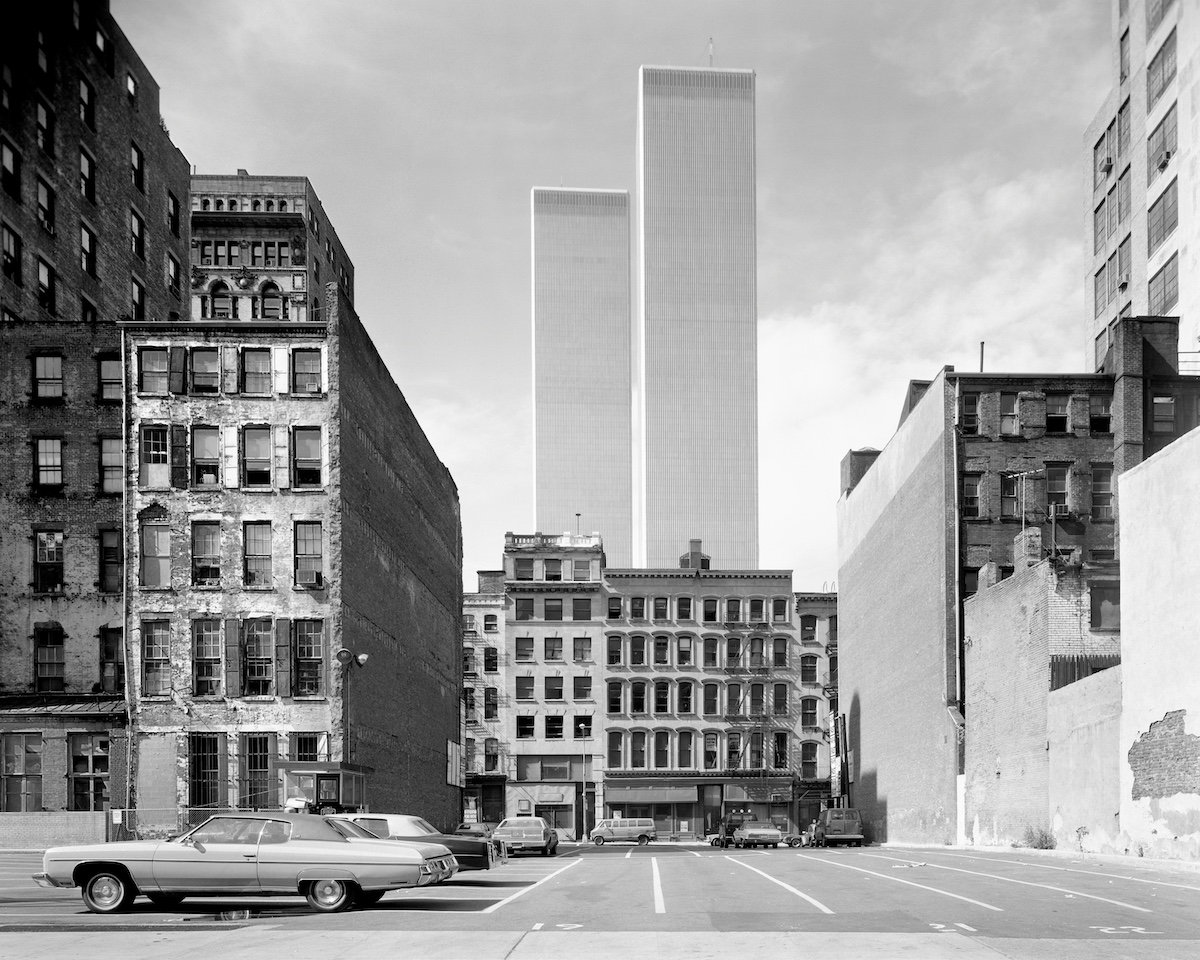
World Trade Center as seen from Cortlandt Street (1975–1979)
Coming of age in Chinatown, Baldwin Lee remembers New York’s fabled neighborhood as “a small village” during the 1950s and ‘60s. As a young boy living on Mulberry Bend, he spent countless days playing in Columbus Park until dinner time. “It was idyllic,” Lee says.
As the first-born son of Chinese immigrants, he carried the weight of academic achievement from a young age. Valedictorian of his class at Brooklyn Tech, Lee enrolled at M.I.T. as an engineering student to make his parents proud, only for their dream to become his nightmare. Then he discovered photography, and soon found himself studying with two of the greatest artists of the 20th century: Minor White at M.I.T. and later Walker Evans at Yale University. “Growing up, I was very sheltered and had little experience outside of Chinatown so Minor White was the first gay man I had ever met, and Walker Evans was an aristocrat. He wore Peal shoes and bought his suits from J. Press, so he was a real dandy,” Lee says.

Where White was romantic, Evans was classical, each critiquing the other’s philosophy to a young Lee, who absorbed both perspectives, seeing two sides of the same coin as one. “The primary thing I got from each man was how serious the profession of photography was, and how hard you had to work at it,” Lee says. “If Walker Evans was interested in a particular subject, he photographed with his 35 millimeter Leica, his two and a quarter Rolleiflex, his 4×5 Speed Graphic, a 5×7 view camera, and his 8×10. He was going to bring back the picture regardless.”
After receiving his MFA from Yale in 1975, Lee began making regular trips to his hometown in search of the muse and found it in a city that had been abandoned by the federal government. Banner headlines like “FORD TO THE CITY: DROP DEAD” made news on their own, portending the systemic collapse of New York to “benign neglect,” arson, and corruption that would continue for years to come. As white flight sent hundreds of thousands into the suburbs, New York reimagined itself as an oasis for artists and outlaws alike.

With the new exhibition, Baldwin Lee: New York (1975–1979), now on view through October 31 at Howard Greenberg in New York, the photographer returns to where it all began. Guiding us from Wall Street to Times Square, Central Park to Front Street in DUMBO long before gentrifiers branded it as such, Lee crafts contemplative portraits of quiet grandeur that has become the hallmark of the New Topographics movement breaking new ground at that time. While photographs by Stephen Shore, Bernd and Hilla Becher, and Robert Adams were on display at the Museum of Modern Art during the winter of ’75, Lee hit the streets with a 4×5 camera in hand, making work all his own while the city gently dozed.
“I loved walking around, especially in cold weather, at dawn,” says Lee. “Oftentimes I would be the only person on the street and felt as if New York was my private garden. I was seeing the human side of buildings.” He found sanctuary in solitude, embracing the curious topography of a city whose most telling feature was in its name: New. Just two years earlier, the World Trade Center rose from the tip of the island, erasing centuries of working class life, in the name of global capital and “urban renewal.” But more pragmatically, the towers functioned as a street compass pointing south, offering an inexplicable feeling of being anchored in a chaotic world.

Amidst the vast canyons of Manhattan, Lee recognized the frontier landscape of 19th-century photographers like Timothy O’Sullivan who photographed the Old West during the full-throated rush of Manifest Destiny. Lee’s work speaks of a city poised between the past and the future – a world crumbling into the dust while another rises from the ashes like the phoenix, or more likely, your garden-variety real estate scam. But what remains is a timeless presence buried in bedrock that makes itself felt, like the silence between notes. “It was a time when New York was storied and couched in mythology,” Lee says. “That made it very special to photograph. It wasn’t just pictures of steel and concrete. You were trying to capture a spirit.”

Follow Miss Rosen on Twitter
