
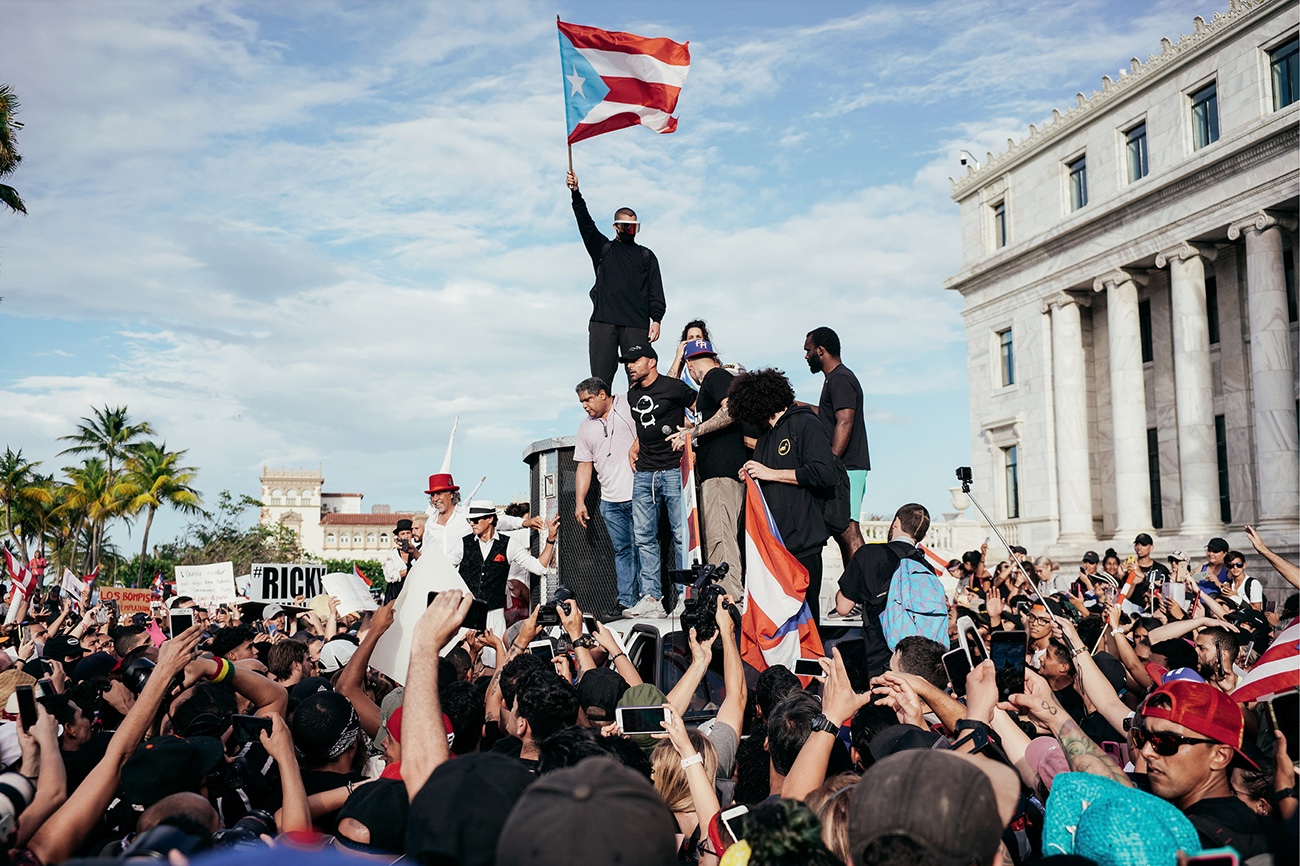
Eric Rojas, Ricky Martin (C), Puerto Rican rapper René Pérez Joglar, aka Residente (R), and Puerto Rican reggaetón singer Bad Bunny (T), take part in a demonstration demanding Governor Ricardo Rosselló’s resignation in San Juan, Puerto Rico, on July 17, 2019
It’s been said, don’t write anything you wouldn’t want read in court. Just ask Ricardo Rosselló, former governor of Puerto Rico, who ignited the events of Verano del 19 (Summer of 2019). On July 13 of that year, 899 pages of Telegram messages between Rosselló and his associates came to light, their racist, homophobic, and sexist commentary punctuated by more insidious plans for the island in the wake of Hurricane Maria. “I saw the future, and it was marvelous, there were no Puerto Ricans,” publicist Edwin Miranda wrote without concern that his words would one day spark a revolution.
Four days later, musicians Residente (René Pérez Joglar), iLe, and Bad Bunny released “Afilando los cuchillos” (“come on, we’re sharpening the knives”), demanding Rosselló resign, igniting the passions of the people who had taken to the streets in the largest protest on the island in recent memory. Half a million residents — 15% of the island’s population — came out strong, chanting “Ricky, renuncia!” (“Ricky, resign!”), while police shot tear gas into the crowds outside the governor’s mansion. On July 24, Rosselló posted a recorded message on Facebook, announcing he would step down and slither out on August 2, becoming Puerto Rico’s first governor to end his regime in disgrace. “After the birth of my son, this is the happiest day of my life,” Joglar said of the historic occasion.

Among the images to emerge from that week was a photograph by Eric Rojas of Ricky Martin, Residente, and Bad Bunny waving the Puerto Rican proudly overhead, evoking the revolutionary fervor of Eugène Delacroix’s 1830 painting, Liberty Leading the People. While Oscar Wilde believed that “life imitates art far more than art imitates life,” music quickly blurs the boundaries between call and response, each propelling the other into the point of no return. Some call it destiny, while others recognize it as a masterpiece. It is here that Dancing the Revolution: From Dancehall to Reggaetón, begins.
Dancing the Revolution was presented as an exhibition at MCA Chicago and followed the sounds of Kingston and San Juan across New York, London, and Panama, through the work of 42 artists including Jean-Michel Basquiat, musicians Lee “Scratch” Perry, Phil Collins, and photographers Beth Lesser, Dennis Morris, and Adrian Boot. “Dancehall and reggaetón are not often regarded as subjects of serious academic research or intellectual depth by mainstream scholarship and institutions,” curator Carla Acevedo-Yates writes in the bilingual (English/Spanish) exhibition catalogue, published by Delmonico Books.

Dancing the Revolution sets the record straight, tracing the connections between Afro Caribbean music, dance, and class consciousness that forms the heart and soul of these underground movements. Both began as rebel music, and in turn were criminalized until they could be repackaged by the industry for the white gaze. Earlier this year, Bad Bunny headlined the Super Bowl, his groundbreaking performance a timeless reminder that the revolution will not be televised.
But it might be ignited in places that resist Babylon’s siren song, recognizing creativity as a revolutionary force. Dancing the Revolution touches down on two islands trapped in the snares of the Transatlantic Slave Trade for centuries, the music becoming a force of memory, joy, and resistance — so much so the British banned it throughout the empire during the 17th and 18th centuries. Invariably, the sound of silence proved an untenable proposition by an occupying force that saw colonization as a “civilizing” force.

Music provided the soundtrack in Jamaica in the years leading up to independence as the sound system became the de facto national instrument: for the people, by the people, in their element. Sound system parties were often held in backyards, abandoned lots, makeshift spaces, and the streets, playing the latest records out of legendary crews including Trojan, Downbeat, the Great Sebastian, and Giant. Sound systems introduced the clash format, competition keeping their edges razor sharp while becoming a political and economic force in their own right.
“Taking in the wider context—with youth unemployment, maldistribution of wealth, and crime—the masses, many of whom are perpetuators and creators of dancehall, have been able to amplify their voices about years of dis/enfranchisement and its dis/contents,” Jamaican scholar Sonja Stanley Niaah writes in the catalogue. “The sound system has functioned in similar ways beyond Jamaica’s borders. From Delhi, Tunis, Durban, and Amsterdam, to Bogotá, Bristol, Naples, and São Paulo, sound men and their boxes have plied a musical trade in opposition to the constraints of status and the mainstreams that often reject them.”

Working outside the system, dancehall artists built their own global economy, moving live audiotapes, CDs, VHS tapes, and later DVDs, opening new markets that in turn embraced the music as their own. “Reggae en español, understood in the Republic of Panama as the adaptation of Jamaican reggae sung in our language, emerged in the early 1980s and represented a way of transferring those rhythmic bases to the language and experience of local neighborhoods,” creative director Juan Rivera writes in the catalogue.
Following the 1989 US invasion of Panama, music became a refuge for Rivera.“ “I remember one of the dances that left the biggest impression on me: a sound system clash on the tennis courts at the Hindu Temple on Christmas Eve,” he writes. “It was the first time I had seen so many people from different ethnic groups united by the same thing. We were the people from the Diablos Rojos circuit, with a common aesthetic and energy. I knew I was witnessing the birth of an urban tribe, the same one Aldo Ranks would immortalize in the song ‘Menores de edad,’ in which he sings: ‘I want to go to the dance, but the police won’t let me in because they say I’m too young but no matter what, I’m going to crash it.’”
Follow Miss Rosen on Twitter
